Shadow Chrome: The Font That Commands Attention in a Crowded Digital World
There’s a certain kind of visual magnetism that stops a scroll mid-finger. It’s not just about being loud; it’s about being strategically bold. You see it in the stark, high-contrast logos of emerging streetwear labels, the glitching title cards of a new indie video game, or the arresting headers of a music festival poster. This is the space where Shadow Chrome lives—a typeface engineered for impact, not just ornamentation.
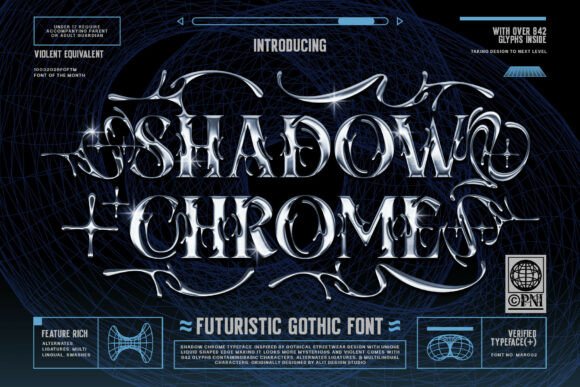
Imagine the sharp, polished edge of a chrome emblem fused with the raw, expressive energy of gothic letterforms. Now, add a subtle, liquid distortion, as if the letters are either solidifying from a digital mist or threatening to dissolve into it. That’s the core of Shadow Chrome. It’s a premium display font that walks the tightrope between heritage and hyperspeed. For designers, it’s less a tool and more a declaration—a way to inject immediate attitude and a high-end, futuristic feel into a project.
More Than a Typeface: A Visual Identity Shortcut
Choosing a font for a brand is like casting the lead actor in a film. The right choice tells the audience everything they need to know in a single frame. Shadow Chrome isn’t for whispering; it’s for announcing. Its aggressive yet sophisticated silhouette carries an inherent narrative of innovation, edge, and a certain uncompromising quality.
Think about the projects where first impressions are everything. A logo design for a tech startup specializing in cybersecurity needs to convey strength and impenetrable intelligence. The sharp, metallic quality of Shadow Chrome achieves this instantly, far more effectively than a standard sans serif font. For a packaging design for a limited-edition energy drink or a high-end audio accessory, the font’s liquid chrome effect suggests cutting-edge technology and premium craftsmanship before the customer even reads the label.
In editorial design, it can dominate a magazine spread or a book cover for a sci-fi thriller, setting an unmistakable mood. The key is recognizing its role: this is your headline act, your hero element. It’s the font that grabs the viewer by the collar and directs them exactly where you want them to look.
Practical Applications: Where Shadow Chrome Truly Shines
Understanding a font’s personality is one thing; knowing how to deploy it is another. Let’s break down where this creative font can become a cornerstone of your visual toolkit.
- Branding & Logo Design: Use it for the primary wordmark or logotype. Its uniqueness ensures high brand recognition. Pair it with a simple, clean serif font or a neutral sans serif font for body copy to create a balanced, professional hierarchy.
- Merchandise & Streetwear: This is its natural habitat. Shadow Chrome screams on t-shirts, hoodies, and hat embroidery. It gives merchandise an instant “collection” feel, elevating a simple graphic into a statement piece.
- Social Media & Digital Advertising: In a feed saturated with Canva templates, a post featuring Shadow Chrome for a key phrase or a call-to-action will stand out. It’s perfect for Instagram story headers, YouTube video thumbnails, or Facebook ad headlines that need to cut through the noise.
- Web Design & Blogs: Use it judiciously for major section headers, hero image text, or the title of a flagship blog post. It adds a layer of modern typography that can make a website feel more dynamic and curated, improving audience engagement right from the homepage.
- Print Materials & Posters: Event posters for concerts, gallery openings, or gaming tournaments are ideal. The font’s high-contrast nature ensures readability from a distance while maintaining its intricate, detailed character up close.
- Packaging & Invitations: For product lines targeting a young, style-conscious demographic—think vinyl records, specialty spirits, or tech gadgets—the font adds perceived value. It also works for event-specific invitations where the theme is futuristic, cyberpunk, or avant-garde.
Making It Work: A Designer’s Practical Guide
Introducing a bold, stylistic font like Shadow Chrome into your workflow requires a bit of strategy to ensure it enhances rather than overwhelms.
Master the Font Pairing. This is non-negotiable. A display font of this caliber needs a quiet partner. Test it alongside a highly legible, neutral body font. A geometric sans serif like Montserrat or a classic serif like Lora can provide the necessary breathing room. The goal is visual consistency—your headline commands attention, and your body copy delivers the information cleanly.
Respect Readability. While the letterforms are distinct, their stylistic edges can become challenging at very small sizes or in long paragraphs. Use it for short, impactful text: headlines, subheads, logos, and single-word accents. For any text longer than a sentence, switch to your paired body font. Always test your designs on multiple devices and in print to check for clarity.
Explore the Included Styles. A quality commercial font like Shadow Chrome often comes with more than one style. Check for alternate characters, different weights, or stylistic sets. These variations can help you tailor the font more precisely to your project’s needs, adding versatility to its striking base design.
Clarify the Licensing. Before using it for a commercial project—a client’s logo, a product for sale, a monetized YouTube channel—verify the license. Ensure it covers your intended use (e.g., desktop, web, app, merchandise). This is a critical step in professional presentation and avoiding legal headaches down the line.
The Final Word on Choosing Your Visual Weapon
In a landscape where visual identity is currency, the tools you choose define your brand’s value. Shadow Chrome isn’t a font for every project. It’s for the ones that need to make a definitive statement. It’s for the designer who understands that typography is a primary vehicle for emotion and perception. If your goal is to craft an identity that feels both rooted in a certain cultural edge and pointedly futuristic, this typeface offers a direct path there. It’s a piece of design asset that doesn’t just fill space—it creates an atmosphere, tells a story, and, most importantly, commands the viewer’s full attention.