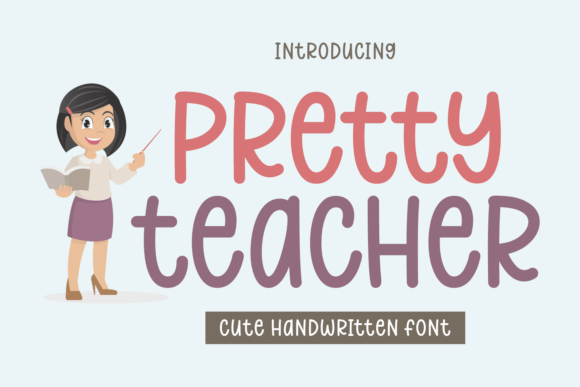
Pretty Teacher: A Font That Brings Whimsy and Warmth to Your Work
You know that feeling when you walk into a room and it just feels... friendly? Like someone's smiling at you without saying a word. That's the energy a typeface can carry, and it's exactly what Pretty Teacher delivers. This handwritten font doesn't just sit on a page—it waves at you. With its rounded, bouncy letterforms and playful imperfections, it channels the warmth of a handwritten note from someone who genuinely cares. Whether you're designing a children's book cover, crafting social media posts for a family-run bakery, or putting together wedding invitations, this font brings an instant sense of approachability that more rigid typefaces simply can't match.
Why Handwritten Fonts Still Win Hearts
There's a reason handwritten fonts have remained popular across design trends and platform shifts. In a world increasingly dominated by sleek sans serif fonts and minimalist interfaces, a hand-lettered style cuts through the visual noise. It signals authenticity. It says, "A real person made this." Pretty Teacher leans into that appeal with its rounded terminals and slightly uneven baselines—the kind of charming imperfections that make digital text feel genuinely human.
This matters more than you might think. Research in consumer psychology consistently shows that people respond more positively to brands that feel personal and approachable. A handwritten font like Pretty Teacher can bridge the gap between polished professionalism and human warmth. It's not about looking sloppy or unfinished. It's about choosing a typeface that communicates personality without sacrificing clarity.
For small business owners especially, this balance is critical. You want your packaging to look credible enough to compete on a shelf, but distinctive enough that someone remembers it. You want your Instagram graphics to feel personal, but not amateurish. That's the sweet spot where Pretty Teacher lives—playful enough to be memorable, structured enough to be taken seriously.
Where This Font Truly Shines
Let's get practical. A font is only as good as the context where you use it, and Pretty Teacher has a surprisingly wide range of applications that play to its strengths.
Children's products and educational materials. This is the obvious one, and for good reason. The rounded, friendly letterforms feel safe and inviting to young readers. Think picture books, activity sheets, classroom posters, learning apps, and kids' clothing labels. The whimsical style naturally appeals to both children and the parents buying for them.
Branding for lifestyle and wellness businesses. Yoga studios, organic skincare lines, artisan bakeries, boutique florists—these businesses thrive on a sense of warmth and personal touch. Pretty Teacher works beautifully for logos, wordmarks, and brand collateral where the goal is to feel approachable rather than corporate. It pairs especially well with earthy color palettes and natural textures.
Social media content. If you're creating quote graphics, story templates, or promotional posts for platforms like Instagram or Pinterest, a handwritten font adds personality that stops the scroll. Pretty Teacher's readability at mid-range sizes makes it a solid choice for overlay text on images, though you'll want to avoid using it for long captions or dense information blocks.
Invitations and event materials. Birthday parties, baby showers, bridal showers, casual weddings, community events—any occasion that calls for celebration and joy benefits from a font that feels handcrafted. Pretty Teacher works well on invitations, thank-you cards, menu cards, and signage where the tone is festive and informal.
Packaging and product labels. For artisan food products, handmade candles, craft supplies, or boutique goods, this font can add a homespun quality that communicates care and craftsmanship. It suggests that someone put thought into every detail, which can justify a premium price point in the consumer's mind.
Digital products and online courses. E-books, workbooks, planners, and course materials designed with Pretty Teacher feel less intimidating than those set in stark, clinical typefaces. For creators in the education or coaching space, this can make your content feel more accessible and encouraging—exactly the vibe you want when someone is learning something new.
Pairing Pretty Teacher With Other Fonts
One of the most common mistakes designers and non-designers alike make is using a single decorative font for everything. A handwritten display font like Pretty Teacher is at its best when it's balanced with a complementary typeface for body text and supporting information.
Here's a simple approach: use Pretty Teacher for headlines, titles, and short bursts of emphasis. Then pair it with a clean sans serif font for paragraphs, descriptions, and any text that needs to be read quickly and comfortably. The contrast between the organic, hand-lettered style and the structured simplicity of a sans serif creates visual hierarchy without feeling disjointed.
You could also pair it with a classic serif font for a slightly more sophisticated look—imagine Pretty Teacher on a wedding invitation headline with a refined serif handling the event details. The key is to let each font do what it does best. Pretty Teacher brings the charm. The supporting font brings the clarity.
Always test your pairings in context. Type out actual words and phrases from your project, not just the alphabet. See how the fonts interact at the sizes you'll actually use. A pairing that looks great in a 72-point headline might fall apart at 14 points on a product label.
Readability: The Non-Negotiable Factor
Handwritten fonts live in a tricky space when it comes to readability. Their charm comes from their personality, but personality can sometimes get in the way of legibility. With Pretty Teacher, the designer made smart choices—the letterforms are distinct enough that common confusion points (like lowercase 'a' versus 'o', or 'r' versus 'n') are handled well. The rounded shapes actually help here, because they create clear internal spaces within each letter.
That said, context matters enormously. At large display sizes—think poster headlines, book titles, hero text on a website—Pretty Teacher is effortless to read. At smaller sizes, especially in long paragraphs or on low-resolution screens, readability starts to drop. This isn't a flaw specific to this font; it's the reality of most handwritten and script typefaces. They're designed for impact, not for extended reading.
A good rule of thumb: if your audience needs to read more than a short sentence or two in this font, consider switching to a more conventional typeface for that text. Use Pretty Teacher where it makes the strongest impression—headlines, logos, pull quotes, call-to-action buttons—and let a workhorse font handle the rest.
Making It Work for Your Brand Identity
Consistency is the backbone of recognizable branding. Once you choose a font as part of your visual identity, it should appear across your touchpoints in a deliberate, repeatable way. If Pretty Teacher becomes part of your brand system, define clear rules for when and how it shows up.
Maybe it's your primary headline font across all social media graphics. Maybe it's reserved for your logo and product names only. Maybe it appears on your website in specific sections—like testimonials or feature callouts—while a different typeface handles navigation and body copy. The specifics depend on your brand's personality and audience, but the principle is universal: use it consistently, and people will start associating that visual style with your business.
Think about how this plays out across different materials. Your Instagram stories, your email headers, your product packaging, your website banners—each of these is a chance to reinforce your brand's visual language. When Pretty Teacher appears across these touchpoints, it creates a thread of familiarity. Customers might not consciously notice the font, but they'll feel the cohesion. That feeling builds trust over time.
Licensing and Practical Considerations
Before you commit any font to a commercial project, understand the licensing. Pretty Teacher, like most premium fonts, comes with specific terms that dictate how you can use it. Typically, a desktop license covers use in printed materials, logos, and static images. If you're embedding the font in a website or app, you may need a separate web or app license. Some licenses are per-user; others cover an entire organization.
Read the license agreement carefully. It's not the most exciting part of the design process, but it protects you legally and ensures the type designer is fairly compensated for their work. If you're purchasing through a reputable marketplace, the licensing terms are usually clearly stated. When in doubt, reach out to the foundry or seller directly.
Also, check what's included in your download. Quality font packages often include multiple styles—regular, bold, italic, and sometimes alternates or ligatures. These extras give you more flexibility in your designs without needing to purchase additional fonts. They also help you create visual variety within a single typeface family, which is incredibly useful for maintaining a cohesive look across different types of content.
At the end of the day, a font choice is a small decision with outsized impact. Pretty Teacher isn't trying to be everything to everyone—and that's precisely what makes it effective. It knows what it is: warm, inviting, and unmistakably human. For the right project, that's exactly what your audience is waiting to see.